NEP ORIENTATION AND SENSITISATION PROGRAMME
November 20 – November 29, 2025
PROGRAMME DETAILS
Programme: Nep Orientation and Sensitisation Programme Mode of Delivery: Online
Duration: 10 Days (Live Sessions on 8 Days)
Time Slot: 2:00 PM to 5:00 PM
Registration Fee: No Registration Fee
Last Date for Registration: November 19, 2025
Registration Website: www.mmc.ugc.ac.in
REGISTRATION PROCESS
Interested participants followed a systematic registration process through the official Malaviya Mission portal:
- Visit the website: https://mmc.ugc.ac.in/
- Click on “Register” and fill in basic information
- Receive confirmation mail with username and password
- Login using credentials and change password on first login
- Click on “Apply for NEP Theme Training” tab
- Select Centre: “Hansraj College, New Delhi”
- Select Month: “NOVEMBER” and State/UT: “Delhi”
- Upload duly signed Nomination Letter
- Choose programme code: MMC-019-2025-NOV-B-06964; 20/11/25 To 29/11/25
- Click on “Participate”
ORGANIZING INSTITUTIONS
Primary Organizer
Mahatma Hansraj Malaviya Mission Teacher Training Centre (MH-MMTTC)
Hansraj College, University of Delhi (NAAC Accredited A++ Grade)
Collaborating Institution School of Liberal Arts
Noida International University, Greater Noida
Under the Aegis of
Malaviya Mission Scheme, University Grants Commission (UGC)
ELIGIBILITY AND TARGET PARTICIPANTS
The programme was interdisciplinary and open to all interested participants. All faculty members (Permanent/Temporary/Ad hoc/Guest) from any university or college were eligible to participate. The programme was designed to be taken into consideration for Career Advancement Scheme (CAS) of UGC, thereby encouraging wider participation among teaching professionals.
ABOUT THE ORGANIZING INSTITUTIONS
Hansraj College, University of Delhi
Hansraj College stands as one of the largest constituent colleges of University of Delhi and has been consistently ranked among the top five colleges for Science, Arts, and Commerce several
times in the last decade. The college has earned NAAC Accreditation with A++ Grade, reflecting its commitment to academic excellence.
The faculty and students of the college have contributed immensely in the fields of academics, sports, and cultural activities. The college faculty demonstrates dedication towards institutional growth and development both academically and administratively, constantly striving for excellence. They have been placed in diverse professions and services worldwide, bringing fame and laurels to the institution.
Noida International University
Established under U.P. Legislature Act No. 27 of 2010 and recognized under Section 2(f) of the UGC Act, 1956, Noida International University (NIU) is a world-class institution sponsored by the Maruti Educational Trust. Strategically located near the Yamuna Expressway in Gautam Budh Nagar, Greater Noida, NIU offers diverse programs through its 12 schools covering fields such as Engineering, Management, Law, Medical Sciences, Nursing, Social Sciences, Pharmacy, Fine Arts, Education, and Sciences & Allied Sciences.
With students from over 54 nations, NIU stands as a global educational destination. The university achieved an A+ Grade in the first cycle of NAAC accreditation with a remarkable score of 3.44 out of 4, making it the highest-rated private state university in India.
School of Liberal Arts, NIU
Established in 2011, the School of Liberal Arts at Noida International University explores various aspects of human society, working towards the creation and proliferation of life skills, critical thinking, imagination, creativity, aesthetics, and pragmatic analysis of life. The school aims at providing novel experiences to students through seminars, workshops, guest lectures, media sessions, and expert talks. The School of Liberal Arts maintains regular interactions with industry, NGOs, and government agencies to help students gain understanding of actual work challenges.
PROGRAMME INTRODUCTION
The Malaviya Mission Teacher Training Programme was organized in alignment with the National Education Policy (NEP) 2020 objectives. The Ministry of Education (MoE) has sought to strengthen synergy and integration between Human Resource Development Centres (HRDCs) and Pandit Madan Mohan Malaviya National Mission on Teachers and Teaching (PMMMNMTT) centres to meet the objectives of NEP 2020.
The programme was designed to implement key recommendations of NEP 2020, focusing on improving the quality of teaching at all levels and domains, promoting equity and inclusion in higher education, advancing online and digital education, ensuring equitable use of technology, promoting Indian languages and culture, and developing leadership and management skills among educators.
The MMTTP aimed to:
- Orient faculty members towards the principles and implementation strategies of NEP 2020
- Enhance understanding of holistic and multidisciplinary education approaches
- Promote awareness of Indian Knowledge Systems in contemporary education
- Develop academic leadership, governance, and management capabilities
- Sensitize participants about student diversity and inclusive education practices
- Foster research and development culture in higher education institutions
- Emphasize skill development and vocational education integration
- Advance the adoption of Information and Communication Technology in teaching- learning processes
- Create a pool of mentors and pedagogic experts aligned with NEP vision
THEMES COVERED:
The programme comprehensively addressed eight core themes aligned with NEP 2020:
- Holistic and Multidisciplinary Education
- Indian Knowledge Systems
- Academic Leadership, Governance, and Management
- Higher Education and Society
- Research and Development
- Skill Development
- Student Diversity and Inclusive Education
- Information and Communication Technology
PROGRAMME PROCEEDINGS:
The training programme was conducted over ten days with live interactive sessions on eight days, structured as follows:
DAY 1 – NOVEMBER 20, 2025
Session 1: Skill Development (2:00 PM – 3:30 PM)
Resource Person: Dr. Amita Dutt, Former Dean, Faculty of Fine Arts, Rabindra Bharati University (RBU), Kolkata
This inaugural session focused on the critical role of skill development in NEP 2020’s vision for higher education. Dr. Dutt emphasized the integration of vocational education within the academic curriculum and discussed strategies for developing both hard and soft skills among students. The session explored how liberal arts education can be enhanced with practical skill- based components, the importance of creativity and artistic skills in holistic development, and methods for bridging the gap between theoretical knowledge and industry requirements.
Participants were introduced to innovative pedagogical approaches that combine academic rigor with skill-based learning outcomes.
Session 2: Holistic and Multidisciplinary Education (3:30 PM – 5:00 PM)
Resource Person: Prof. B K Tripathi, Founder Director, Inter University Centre for Teacher Education (IUCTE), Varanasi
Prof. Tripathi provided a comprehensive overview of NEP 2020’s emphasis on holistic and multidisciplinary education. The session covered the philosophical underpinnings of holistic education that focuses on developing the complete individual—intellectual, emotional, social, physical, artistic, creative, and spiritual dimensions. Participants explored how multidisciplinary approaches break down traditional subject silos, the importance of flexible curricula that allow students to choose subjects across disciplines, and strategies for implementing integrated learning experiences. The session highlighted the shift from specialized education to broad-based learning with multiple entry and exit points.
DAY 2 – NOVEMBER 21, 2025
Session 1: Indian Knowledge System (2:00 PM – 3:30 PM)
Resource Person: Prof. Shivani, Department of Philosophy, Panjab University, Chandigarh
Prof. Shivani introduced participants to the rich philosophical traditions of Indian Knowledge Systems (IKS) and their relevance in contemporary education. The session explored ancient Indian contributions to mathematics, science, philosophy, arts, and social sciences. Discussions included methods for integrating IKS into modern curricula without compromising scientific temper, the value of indigenous knowledge in solving contemporary challenges, and approaches to teaching Indian languages, culture, and values. The session emphasized how NEP 2020 seeks to reclaim India’s intellectual heritage while maintaining global academic standards.
Session 2: Holistic and Multidisciplinary Education (3:30 PM – 5:00 PM) Resource Person: Prof. Nalin K Shastree, Retd. Professor, Magadh University
Prof. Shastree expanded on the multidisciplinary theme by providing practical frameworks for implementation. The session covered designing multidisciplinary courses, creating collaborative teaching environments across departments, and assessment strategies for integrated learning. Participants discussed challenges in moving away from rigid disciplinary boundaries and explored successful case studies of multidisciplinary programs. The session also addressed how faculty members can adapt their teaching methodologies to support students pursuing diverse subject combinations and the administrative changes required to facilitate flexible learning pathways.
Session 1: Academic Leadership, Governance and Management (2:00 PM – 3:30 PM)
Resource Person: Prof. A. K. Bakshi, Former VC, BDM University; Retd. Professor, University of Delhi
Prof. Bakshi addressed the crucial aspects of academic leadership required to implement NEP 2020 effectively. The session covered transformational leadership in educational institutions, principles of good governance in higher education, strategic planning and vision development, and financial management for academic excellence. Participants engaged with topics including faculty development and motivation, managing change and resistance in traditional institutions, building collaborative institutional cultures, and ensuring accountability and transparency. The session emphasized that successful NEP implementation requires strong, visionary leadership at all levels of educational administration.
Session 2: Curriculum & Pedagogy (3:30 PM – 5:00 PM)
Resource Person: Prof. Vimal Rarh, Department of Chemistry, SGTB Khalsa College; Director, MMTTC, SGTB Khalsa
Prof. Rarh provided insights into designing NEP-aligned curricula and innovative pedagogical approaches. The session explored outcome-based curriculum design, competency-based learning frameworks, and student-centric teaching methodologies. Discussions included moving from teacher-centered to learner-centered classrooms, incorporating experiential learning, project-based learning, and problem-solving approaches, and methods for continuous and comprehensive evaluation. The session highlighted how curriculum flexibility and choice- based credit systems empower students while maintaining academic rigor and quality standards.
DAY 4 – NOVEMBER 25, 2025
Session 1: Indian Knowledge System (2:00 PM – 3:30 PM) Resource Person: Prof. Neelam Rani, IIM Shillong
Prof. Rani brought a management perspective to Indian Knowledge Systems, exploring indigenous management practices and business ethics rooted in Indian philosophy. The session covered ancient Indian approaches to leadership, governance, and organizational management, the relevance of texts like Arthashastra and Thirukkural in modern management education, and integrating ethical values from Indian traditions into professional education. Participants discussed how IKS can inform sustainable business practices and corporate social responsibility, bridging traditional wisdom with contemporary professional education.
Session 2: Research & Development (3:30 PM – 5:00 PM) Resource Person: Prof. Anjala Kalsie, FMS, University of Delhi
Prof. Kalsie addressed the research and innovation agenda of NEP 2020. The session covered establishing a research culture in undergraduate and postgraduate programs, mentoring
students in research methodologies and ethics, promoting interdisciplinary research projects, and connecting academic research with industry needs and societal challenges. Participants explored mechanisms for encouraging faculty research productivity, creating research infrastructure in colleges and universities, and fostering innovation and entrepreneurship through research. The session emphasized NEP’s vision of making India a global knowledge superpower through robust research ecosystems.
DAY 5 – NOVEMBER 26, 2025
Session 1: Student Diversity and Inclusive Education (2:00 PM – 3:30 PM) Resource Person: Dr. Bhawana Sharma, Himachal Pradesh University
Dr. Sharma focused on creating inclusive educational environments that celebrate diversity and ensure equity. The session addressed understanding diverse student populations including socio-economic, cultural, linguistic, and ability differences, strategies for inclusive classroom practices and universal design for learning, addressing learning disabilities and special educational needs, and gender sensitization and LGBTQ+ inclusion in campus spaces. Participants discussed removing barriers to education for marginalized communities, scholarship schemes and support systems for disadvantaged students, and creating psychologically safe and supportive learning environments for all students.
Session 2: Higher Education and Society (3:30 PM – 5:00 PM) Resource Person: Dr. Debjani Roy, Ranchi University
Dr. Roy explored the symbiotic relationship between higher education institutions and society. The session covered higher education’s role in social transformation and nation-building, community engagement and social responsibility of universities, addressing social issues through education and research, and promoting democratic values, constitutional principles, and civic responsibility. Discussions included university-community partnerships and outreach programs, education for sustainable development and environmental consciousness, and preparing socially responsible global citizens. The session emphasized that educational institutions must serve broader societal interests beyond individual career advancement.
DAY 6 – NOVEMBER 27, 2025
Session 1: Higher Education and Society (2:00 PM – 3:30 PM)
Resource Person: Dr. Nishevita Jayendran, Tata Institute of Social Sciences, Mumbai
Dr. Jayendran provided a critical perspective on higher education’s societal impact with particular emphasis on social justice and equity. The session explored education as a tool for social mobility and empowerment, addressing caste, class, and gender disparities in higher education access, decolonizing curriculum and pedagogical practices, and social work education and community intervention approaches. Participants engaged with topics including
the role of higher education in addressing poverty, inequality, and discrimination, building institutions that reflect India’s diversity and democratic values, and activist scholarship and engaged research for social change.
Session 2: Skill Development (3:30 PM – 5:00 PM)
Resource Person: Dr. Bharat Bhushan Dash, Faculty of Management Studies, Sri Sri University
Dr. Dash presented practical approaches to integrating skill development into management and professional education. The session covered 21st-century skills including critical thinking, communication, collaboration, and creativity, developing leadership, teamwork, and interpersonal skills, digital literacy and technology skills for the modern workplace, and entrepreneurship education and startup incubation. Participants discussed industry-academia collaboration for skill-based training, internships, apprenticeships, and experiential learning opportunities, and assessment and certification of skill competencies. The session emphasized preparing students not just for jobs but for lifelong learning and career adaptability.
DAY 7 – NOVEMBER 28, 2025
Session 1: Information and Communication Technology (2:00 PM – 3:30 PM) Resource Person: Dr. Ashutosh Yadav, Hansraj College, University of Delhi
Dr. Yadav introduced participants to the transformative potential of ICT in education. The session covered leveraging digital tools and platforms for effective teaching and learning, online and blended learning models: benefits and challenges, creating digital content and open educational resources (OER), and using learning management systems (LMS) for course delivery and assessment. Discussions included artificial intelligence, machine learning, and educational technology innovations, ensuring digital equity and bridging the digital divide, and cybersecurity, digital citizenship, and ethical use of technology. The session emphasized how NEP 2020 envisions technology as an enabler of access, equity, and quality in education.
Session 2: Student Diversity and Inclusive Education (3:30 PM – 5:00 PM) Resource Person: Dr. Richa Chopra, IIT Kharagpur
Dr. Chopra brought a technical education perspective to inclusive practices. The session addressed increasing diversity in STEM fields and overcoming gender stereotypes, creating inclusive environments in traditionally male-dominated disciplines, accessible laboratory and technical education facilities for students with disabilities, and mentorship programs for underrepresented groups in engineering and technology. Participants explored unconscious bias in evaluation and its mitigation strategies, culturally responsive teaching in technical education, and success stories of inclusive practices in premier technical institutions. The session demonstrated that excellence and inclusion are complementary rather than competing goals.
DAY 8 – NOVEMBER 29, 2025
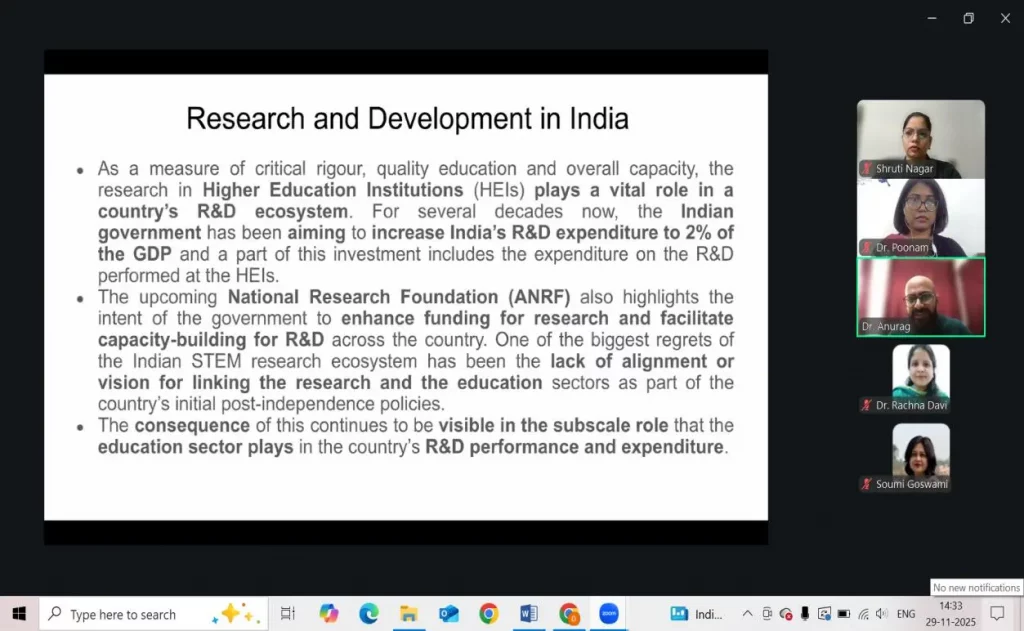
Session 1: Research & Development (2:00 PM – 3:30 PM)
Resource Person: Dr. Anurag Kakkar, Hansraj College, University of Delhi
Dr. Kakkar focused on building research capabilities at the college and university level. The session covered developing research proposals and securing funding from various agencies, publishing research in quality journals and academic writing skills, ethical considerations in research and avoiding plagiarism, and promoting student participation in research from undergraduate level. Participants discussed establishing research centers and collaborative research networks, measuring research impact and quality metrics, and translating research findings into policy and practice. The session provided practical guidance for faculty members to enhance their research productivity while mentoring student researchers.
Session 2: Information and Communication Technology (3:30 PM – 5:00 PM) Resource Person: Prof. Mansaf, Jamia Millia Islamia
Prof. Mansaf concluded the programme with advanced perspectives on ICT integration in education. The session explored emerging technologies in education: virtual reality, augmented reality, and gamification, MOOCs (Massive Open Online Courses) and their impact on democratizing education, data analytics for personalized learning and student success tracking, and building digital infrastructure in educational institutions. Discussions included teacher training for effective technology integration, balancing technology use with human interaction in education, and future trends in educational technology and preparing for Industry 4.0. The session emphasized continuous adaptation to technological changes while maintaining pedagogical soundness and human values in education.
SIGNIFICANCE AND IMPACT
The Malaviya Mission Teacher Training Programme on NEP Orientation and Sensitisation served as a crucial platform for faculty development aligned with national education priorities. The programme successfully:
- Created widespread awareness about NEP 2020 principles and implementation strategies
- Facilitated knowledge exchange among educators from diverse institutional backgrounds
- Built capacity for transformative educational practices in higher education institutions
- Established a network of educators committed to NEP 2020 vision
- Contributed to the creation of a pool of trained mentors and pedagogic experts
The collaborative effort between Hansraj College and Noida International University exemplified the spirit of institutional cooperation envisioned under the Malaviya Mission Scheme, ensuring optimal utilization of infrastructure, human resources, and expertise for advancing the goals of NEP 2020.
ASSESSMENT AND FEEDBACK
Following the completion of all thematic sessions, participants engaged in comprehensive assessment activities and provided feedback on the programme. The assessment evaluated participants’ understanding of NEP 2020 principles across all eight themes and their ability to apply learned concepts in institutional contexts. Participants received certificates recognizing their successful completion of the training programme, which would be considered for Career Advancement Scheme (CAS) under UGC guidelines.
CONCLUSION
The MMTTP (November 2025) represented a significant step toward realizing the transformative vision of NEP 2020 in higher education. By bringing together distinguished resource persons from premier institutions and engaging faculty members across the country, the programme fostered a shared understanding of holistic, inclusive, and quality education. The no-registration-fee policy ensured accessibility and encouraged wide participation, aligning with the equity and inclusion principles of NEP 2020.
The programme stands as a testament to the commitment of MH-MMTTC, Hansraj College, and Noida International University toward building a robust ecosystem of teacher training and professional development, ultimately contributing to the enhancement of teaching quality and educational outcomes in Indian higher education institutions.