Academic Session: 2025-2026 (Even Semester)
Date: 12/02/2026
Mode of Activity: Offline
Venue: Seminar Hall, SBM Building
Timing: 11:30 AM onwards
Target Group: SLA Students, Scholars, and Faculty
Faculty Coordinators: Dr. Devi, Dr. Manju Kundu
Guest Speaker: Prof. (Dr.) Ash Narain Roy, Former Director, Institute of Social Sciences, Delhi
Organized by: School of Liberal Arts, Noida International University
- Introduction
In the context of contemporary India’s developmental trajectory and global positioning, understanding the nexus between economic globalization, sustainable development goals (SDGs), and grassroots governance mechanisms has become increasingly crucial for policymakers, academics, and informed citizens. The guest lecture titled “Vikshit Bharat 2047: Globalization, SDGs and Grassroots Governance in India” was organized to provide scholarly insights into these interconnected dimensions of India’s socio-economic development.
The lecture aimed to foster critical discourse on India’s vision for 2047, examining how globalization shapes development priorities while maintaining grassroots participation and democratic governance. Through this engagement, the School of Liberal Arts sought to deepen students’ and faculty members’ understanding of complex policy frameworks and their real-world implications for Indian society and governance.
- Aims and Objectives
The primary aim of the lecture was to engage participants in a comprehensive discussion on India’s development agenda vis-à-vis global integration and localized governance structures. The specific objectives were:
- Analyze Globalization’s Impact: Examine the implications of economic globalization on India’s developmental pathways and sovereignty considerations.
- Understand SDG Integration: Explore how India’s Sustainable Development Goals align with national development priorities and international commitments.
- Examine Grassroots Governance: Investigate the role of community-level governance mechanisms in achieving inclusive and participatory development at the grassroots level.
- Foster Critical Engagement: Encourage academic discourse on the interconnections between macro-level economic policies and micro-level governance structures affecting ordinary citizens.
- Content
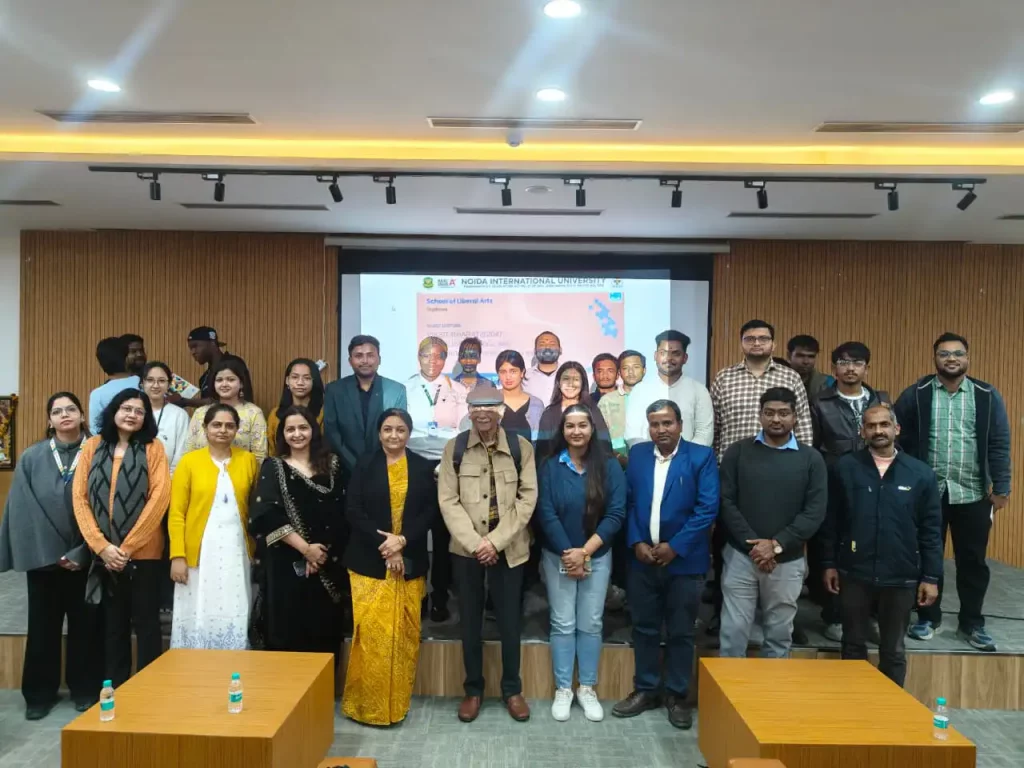
The guest lecture “Vikshit Bharat 2047: Globalization, SDGs and Grassroots Governance in India” was conducted on 12 February 2026 at the Seminar Hall, SBM Building, from 11:30 AM onwards. The session commenced with a formal welcome address by the student coordinators, highlighting the relevance and timeliness of the topic in India’s contemporary policy landscape.
The lecture was delivered by the distinguished resource person, Prof. (Dr.) Ash Narain Roy, Former Director of the Institute of Social Sciences, Delhi, a renowned scholar in international relations, political economy, and development studies. Prof. Roy’s expertise provided a rigorous academic framework for understanding India’s developmental vision and its positioning in the global arena. All students from the School of Liberal Arts actively participated in this engaging and insightful session. The event commenced with the traditional invocation to Goddess Saraswati through lamp lighting. Dr. Aparna Sharma introduced the theme, enlightening the students, and extended a warm welcome to the guest speaker by presenting a sapling.
Key Themes Discussed:
Globalization and India’s Economic Integration: Prof. Roy provided a nuanced analysis of how globalization has reshaped India’s economic structure, creating both opportunities and challenges. He examined India’s engagement with international markets, trade relationships, and the implications for domestic industries and employment.
Sustainable Development Goals (SDGs) in Indian Context: The lecture explored how India’s national development agenda corresponds with the UN’s Sustainable Development Goals. The discussion included India’s progress on key indicators such as poverty reduction, education, health, environmental sustainability, and gender equality.
Grassroots Governance Mechanisms: Prof. Roy emphasized the importance of decentralized governance systems and the role of local institutions in ensuring that development benefits reach marginalized and underserved communities. He discussed Panchayati Raj systems, community participation, and the integration of bottom-up approaches in policy implementation.
Vision 2047: The broader framework of India’s aspirational development narrative by 2047—marking India’s centenary of independence—was contextualized within the discussion, emphasizing the need for inclusive, sustainable, and globally competitive development.
The lecture was characterized by rigorous academic engagement, evidence-based argumentation, and substantive examples drawn from policy implementation across different Indian states and sectors. Prof. Roy encouraged active questioning and dialogue, fostering an interactive learning environment where participants could engage with complex policy questions.
- Outcome
The guest lecture successfully achieved its pedagogical objectives by providing participants with scholarly perspectives on India’s development challenges and opportunities. Key outcomes included:
- Enhanced Policy Understanding: Students and faculty gained deeper insights into the multifaceted relationship between globalization, development goals, and localized governance structures.
- Critical Perspective Development: The lecture stimulated critical thinking on how macro-level international policies intersect with grassroots-level governance and community welfare.
- Informed Discourse: Participants left with a more nuanced understanding of India’s 2047 vision and the policy pathways required to achieve sustainable, inclusive development.
- Academic Engagement: The interactive nature of the session fostered scholarly dialogue and encouraged participants to consider research questions at the intersection of international relations, development studies, and political economy.
- Conclusion
The guest lecture concluded with a comprehensive Q&A session, reflecting the academic rigor and engagement of the audience. Participants demonstrated keen interest in the interconnections between global economic processes and localized governance mechanisms, underscoring the relevance of such academic engagements in higher education.
The School of Liberal Arts extends its sincere gratitude to Prof. (Dr.) Ash Narain Roy for his erudite and insightful presentation on India’s developmental trajectory and global positioning. His scholarly expertise enriched the academic discourse and contributed significantly to students’ and faculty members’ professional development.
The school also appreciates the dedicated efforts of the Faculty Coordinators, Dr. Devi and Dr. Manju Kundu, in organizing the lecture and ensuring its successful execution. After the session concluded, a memento was presented to the guest speaker. Dr. Devi formally proposed the vote of thanks on behalf of Noida International University. The enthusiastic participation of students, scholars, and faculty members from across the university contributed immensely to the success and scholarly value of the event.
Through such academic engagements, the School of Liberal Arts reaffirms its commitment to fostering critical thinking, informed citizenship, and scholarly discourse on contemporary issues of national and global significance.