Academic Session: 2025–2026 (Even Semester)
Date: 29/01/2026
Mode of Activity: Offline
Venue: Seminal Hall, Administrative Block
Timing: 02:00 PM onwards
Target Group: SLA Students, Scholars and Faculty
Event/Activity Coordinators: Dr. Manju Kundu, Dr. Arijit Ghosh
Resource Person: Dr. Nisha Misra
Organized by: School of Liberal Arts, Noida International University
- Introduction
Design thinking has emerged as a powerful approach to problem-solving that emphasizes creativity, empathy, and innovation. The session titled “Design Thinking Conversations: Communicating Ideas, Empathy, and Innovation” was organized to highlight the importance of human-cantered thinking in addressing complex challenges in communication, academia, and professional practice.
In the context of higher education, design thinking plays a vital role in nurturing critical thinking, collaboration, and innovative mindsets among students. By focusing on empathy and effective communication, the session aimed to equip learners with the skills required to generate meaningful ideas and translate them into impactful solutions. Such academic engagements contribute significantly to developing socially aware and forward-thinking individuals.
- Aims/Objectives
The primary aim of the session was to introduce participants to the concept and application of design thinking in communication and innovation. The specific objectives of the session were:
- Develop empathy by deeply understanding user needs and perspectives through guided conversations.
- Enhance communication skills for articulating and refining innovative ideas collaboratively.
- Foster innovation by applying design thinking principles to generate human-centered solutions.
- Content
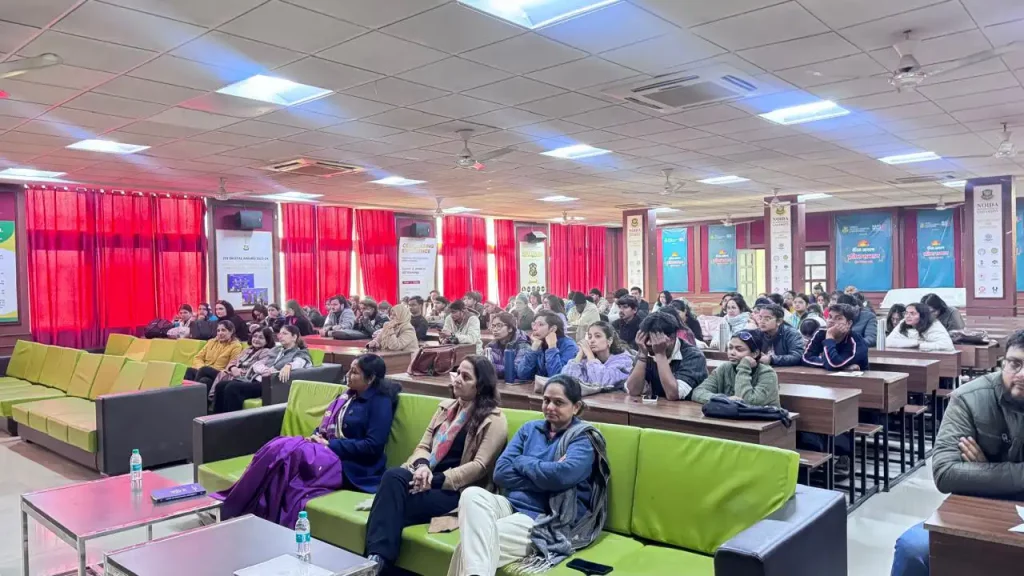
The event “Design Thinking Conversations: Communicating Ideas, Empathy, and Innovation” was conducted on 29 January 2026 at the Seminal Hall, SBM, from 2:00 PM onwards. The session began with a brief introduction by the event coordinators, highlighting the relevance of design thinking in contemporary education and communication practices.
The session was led by the esteemed resource person, Dr. Nisha Misra, Associate Professor, Amity Institute of Corporate Communication, Amity University Noida. Dr. Misra delivered an insightful and engaging talk on the fundamentals of design thinking, focusing on empathy-driven communication, ideation processes, and innovative problem-solving strategies. She illustrated her concepts through practical examples, interactive discussions, and real-life case studies, which helped participants connect theory with practice.
The session encouraged active participation from students, scholars, and faculty members, fostering an interactive learning environment. Participants engaged in discussions that emphasized collaboration, creativity, and the importance of understanding user perspectives while communicating ideas.
- Outcome
The session successfully achieved its objectives by enhancing participants’ understanding of design thinking and its practical relevance. Students and faculty gained valuable insights into how empathy and effective communication contribute to innovation and creative problem-solving.
The interactive nature of the session motivated participants to reflect on their own approaches to communication and idea generation. The discussions and exchanges of ideas demonstrated increased awareness of human-centered thinking and its application in academic, professional, and social contexts.
- Conclusion
The session concluded on a positive and enriching note, leaving participants with a deeper appreciation of design thinking as a tool for innovation and empathetic communication. The event reinforced the role of academic institutions in fostering creativity, critical thinking, and socially responsible innovation.
The School of Liberal Arts extends its sincere gratitude to Dr. Nisha Misra for her valuable insights and engaging delivery. Appreciation is also extended to the Dean, SLA Prof (Dr. Aparna Sharma, event coordinators, Dr. Manju Kundu, and Dr. Arijit Ghosh, for their dedicated efforts in organizing the session successfully. The enthusiastic participation of students, scholars, and faculty members contributed greatly to the success of the event.