Date: 23/02/2026
Mode of Activity: Hybrid
Venue: SBM Seminar Hall/Google Meet
Online link:- Video call link: https://meet.google.com/roz-saad-vok
Timing: 1:30 PM onwards
Target Group: SLA Students (Graduation and Post Graduation), Scholars and Faculty
Event/Activity Coordinator: Dr. Manju Kundu
Resource Person: Prof. Halina Marlewicz, Ph.D.
Organized by: School of Liberal Arts, Noida International University
- Introduction
Hybrid knowledge systems represent a fascinating intersection of indigenous and colonial epistemologies, particularly in the context of Bengal during British rule. The International Expert Talk titled “Ideation of Hybrid Knowledge Systems: The Case of Colonial Bengal” was organized under the Institutions’ Innovation Council (IIC) 8.0 Activity to explore these dynamics.
In the context of higher education, such sessions play a vital role in nurturing critical historical analysis, decolonial perspectives, and innovative thinking among students. By focusing on epistemic innovations through interactions like translations and institutions such as Fort William College, the talk aimed to equip learners with insights into blending traditional Indian knowledge with Western influences for modern relevance.
Such academic engagements contribute significantly to developing historically aware and forward-thinking individuals.
- Aims/Objectives
The primary aim of the session was to introduce participants to the ideation processes behind hybrid knowledge systems in colonial Bengal and their contemporary implications.
The specific objectives of the session were:
- To examine emergence of mixed knowledge through Bengali-Western interactions.
- To highlight ideation via translations and institutions like Fort William College.
- To decolonize history by focusing on Bengal’s epistemic innovations.
- To link to modern integration of Indian Knowledge Systems
- Content
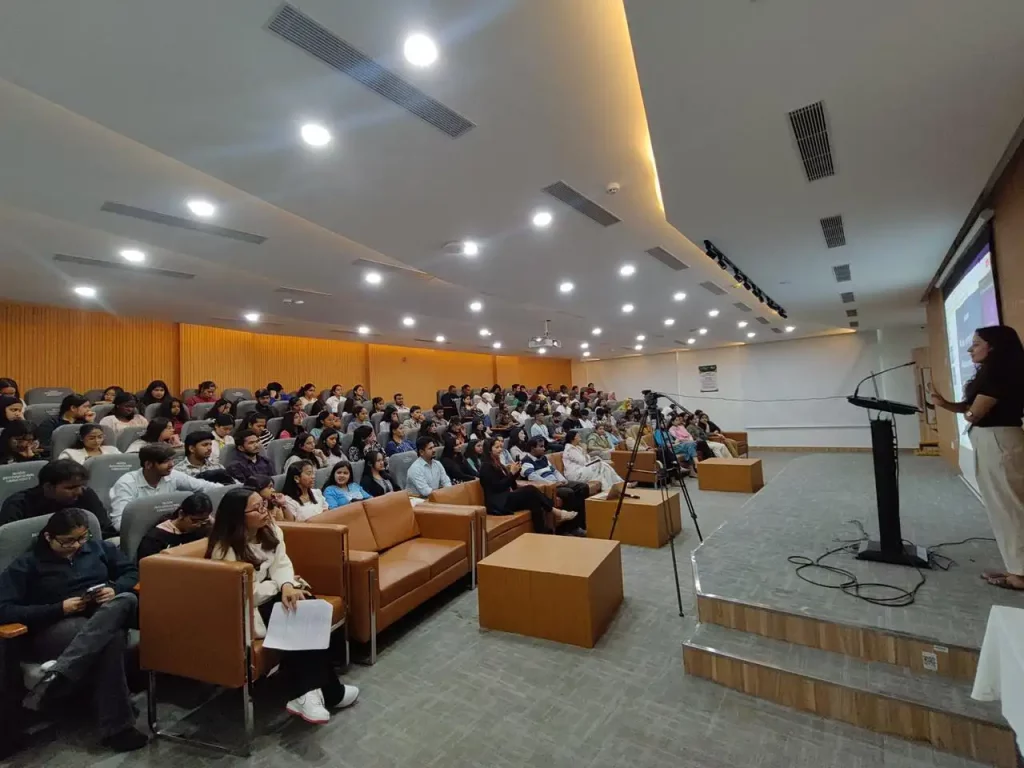
The event “Ideation of Hybrid Knowledge Systems: The Case of Colonial Bengal” was conducted on 243rd February 2026 at the SBM Seminar Hall (Hybrid Mode) from 1:30 PM IST onwards. The session began with a brief introduction by the event coordinator, Dr. Manju Kundu, highlighting the relevance of hybrid epistemologies in contemporary education and innovation practices. The Session was well managed by the Students Coordinators Ms. Santoshi and Ms . Anyba who moderate the whole session wonderfully. The session was led by the esteemed resource person, Prof. Halina Marlewicz, Ph.D., Head of Department of Languages and Cultures of India and South Asia, Institute of Oriental Studies, Jagiellonian University, Kraków, Poland. Prof. Marlewicz delivered an insightful and engaging talk on the fundamentals of hybrid knowledge ideation, focusing on colonial Bengal’s interactions, translation movements, and institutional innovations. She illustrated her concepts through historical examples, interactive discussions, and case studies from Fort William College, which helped participants connect theory with decolonial practice. She has added and focus on the ideation, translation and which was well alien with the IKS , was main highlights of the event. The session encouraged active participation from students, scholars, and faculty members, fostering an interactive learning environment that emphasized critical reflection on epistemic shifts.
- Outcome
The session successfully achieved its objectives by enhancing participants’ understanding of hybrid knowledge systems and their practical relevance. Students and faculty gained valuable insights into how colonial interactions fostered epistemic innovations and their application to modern Indian Knowledge Systems. The interactive nature of the session motivated participants to reflect on decolonial approaches to history and knowledge production.
The discussions demonstrated increased awareness of hybrid thinking and its role in academic and innovative contexts.
- Conclusion
The session concluded on a positive and enriching note, leaving participants with a deeper appreciation of hybrid knowledge systems as a tool for decolonial innovation and historical insight. The students had many questions followed by the staff. The event reinforced the role of academic institutions in fostering critical thinking, historical analysis, and socially responsible knowledge integration. On behalf of Noida International University and The School of Liberal Arts Prof.(Dr) Aparna Sharma, Dean SLA extends its sincere gratitude to Prof. Halina Marlewicz for her valuable insights and engaging delivery.
Even Prof.(Dr) Halina has also express her gratitude towards to the Vice Chancellor/Dean, SLA Prof. Dr. Aparna Sharma, and event coordinator Dr. Manju Kundu for their dedicated efforts in organizing the session successfully. The enthusiastic participation of students, scholars, and faculty members contributed greatly to the success of the event. Over all it was such enrichen , engaging and wonderful session and well informative .