Men's Mental Health Awareness Week
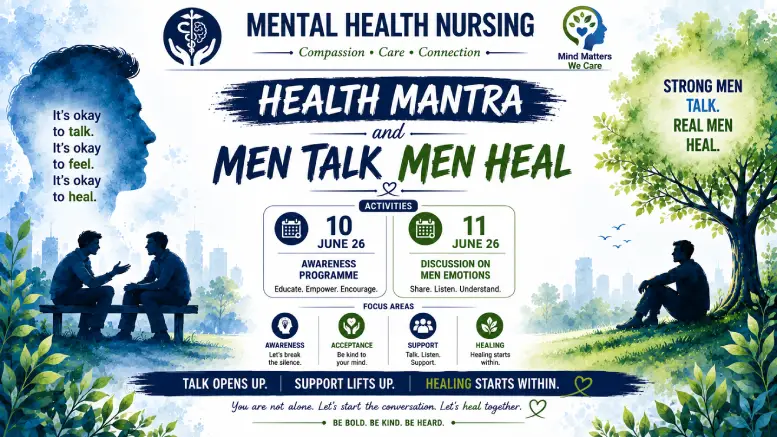
“Health Mantra and Men Talk Men Heal 2026”
Department of Mental Health Nursing, School of Nursing
Noida International University
10th & 11th June 2026
Event Details
Event Overview
The Department of Mental Health Nursing, School of Nursing, Noida International University, successfully organized a two-day mental health awareness programme titled “Health Mantra and Men Talk Men Heal” on 10th and 11th June 2026 in observance of Men's Mental Health Awareness Week.
The programme aimed to promote awareness regarding men's mental health, encourage emotional expression, reduce stigma associated with seeking help, and foster a supportive environment for mental well-being. The event emphasized that mental health is equally important as physical health and encouraged participants to openly discuss emotional challenges and coping strategies.
The programme included awareness sessions for male support staff and interactive discussions among male faculty members and participants, creating a platform for open communication and mutual support.
Objectives of the Event
- To increase awareness regarding men's mental health and emotional well-being.
- To encourage healthy conversations about emotions and mental health challenges.
- To reduce stigma associated with seeking psychological help.
- To promote self-care, resilience, and emotional support among men.
- To create a supportive and inclusive environment for discussing mental health concerns.
Patrons & Leadership
Hon’ble Chairman, Noida International University
Hon’ble Chancellor, Noida International University
Hon’ble Vice Chancellor, Noida International University
Dean – Quality Assurance & Accreditation, Noida International University
Director, School of Nursing, Noida International University
Programme Highlights
Day 1 – Health Mantra (10th June 2026)
A special awareness programme was conducted for male support staff (Class D workers) of the university. The session focused on:
- Understanding mental health and emotional well-being.
- Recognizing signs of stress, anxiety, and emotional distress.
- Importance of seeking support and professional help when needed.
- Stress management techniques and self-care practices.
- Building positive coping strategies for everyday challenges.
Participants actively engaged in discussions and shared their experiences, making the session interactive and meaningful.
Day 2 – Men Talk Men Heal (11th June 2026)
An interactive discussion session was organized for male faculty members and participants. The programme provided a safe and supportive space for men to express their thoughts, emotions, and life experiences.
Activities included:
- Open discussion on men's emotional well-being.
- Sharing personal experiences and coping mechanisms.
- Group reflection activities.
- Awareness talk on breaking stereotypes related to masculinity and mental health.
- Encouraging peer support and healthy communication.
The session highlighted the importance of listening, understanding, and supporting one another.
Focus Areas
Participation
- Male support staff (Class D workers)
- Faculty members
- Nursing students
- Mental Health Nursing Department faculty
Total Participation: Approximately 100 participants.
Outcomes of the Event
- Increased awareness regarding men's mental health issues.
- Enhanced understanding of emotional well-being and self-care practices.
- Encouraged open discussions about emotions and mental health challenges.
- Reduced stigma associated with seeking mental health support.
- Strengthened a culture of empathy, acceptance, and mutual support within the university community.
- Participants appreciated the initiative and expressed the need for more such programmes in the future.
Conclusion
The “Health Mantra and Men Talk Men Heal” programme was successfully conducted and achieved its objectives of promoting mental health awareness among men. The event encouraged participants to communicate openly, seek support when needed, and prioritize their emotional well-being. Through awareness sessions and meaningful discussions, the programme contributed to creating a healthier, more supportive, and mentally resilient university community.